Saturday, February 26, 2011

Journey to the South (Part I)

My journey started in the City Lloydminster, Alberta, Canada which is at 53°17'N 110°0'W. Why is this important? Because the internationally, Antarctica is defined as being within the 60°S latitude. This is truly a journey “across” the world.

The nearest international airport is just south of Edmonton, however my family booked flights out of Calgary so on December 10, 2010 I began the 6 hour drive south. I stayed a couple days in Edmonton where I visited my grandparents and boyfriend, and arrived home in Calgary on December 12, 2010 just in time for my dad’s birthday where we celebrated by going for all-you-can-eat sushi. On December 13, I went snow-shoeing with my parents at Chester Lake, and had dinner with Calgary friends. December 14 was spent in preparation for travel.

December 15 at 5:00 AM we all headed to the Calgary airport. Janna and I would make the journey on our own and our parents on a separate path due to how our cabins on the ship were booked. Janna and I first flew to Dallas, Tx where we had a 7 hour stop-over which is enough time to eat at a gourmet Mexican restaurant, take photos of all of the art in the terminal and also walk to terminals A, B, and C (we couldn’t figure out how to walk to E).


That evening we boarded an over-night flight to Buenos Aires “the big apple”, Argentina. When we arrived in Argentina we paid our $70 US reciprocation fee per person (apparently Canada, the US and Australia charge Argentine visitors coming into the country so they have also decided to reciprocate), retrieved our bags and soon realized that our parents were not landing in the same terminal. Luckily their terminal was only about a block away. We waited for about another hour for them to come out of the secured area in which I practiced my horrible Spanish skills with random

strangers.

Re-united again (it was a relief!) we caught a non-scam least-suspicious-looking taxi (in Argentina there are “fake taxis” so you must go to the booths inside the airport and order a taxi from there) to Bohemia Buenos Aires Hotel in the suburbs. We are now 4 hours time difference from MST.

At 2 PM we caught a city bus tour and saw the most gigantic avenue ever! It’s called Avenida de 9 Mayo I believe and is at least 16 lands wide with 3 boulevards. We also so the parks, a giant metal flower sculpture, many of the embassies, cathedrals, the soccer field, the Pink House (President’s House) and a poor but culturally rich neighborhood called La Boca (or “the mouth” – of the river). Talk about a lot to see right after stepping of an airplane!


For dinner we found a nice authentic restaurant. It was funny because the waiter was also foreign and spoke more English than Spanish! So I didn’t get to put my “skills” to use. In Argentina, the proportions are monstrous, especially with meat. I can’t even describe how much meat they serve! It’s ridiculous. If you like meat, eat in Argentina.

The next day we were woken by a 5 AM alarm once again where we caught a non-suspicious taxi to the municipal airport, Jorge Newberry (Jorge is the Spanish equivalent of the name George) for our flight to the southern most city in the world, Ushuaia, Argentina (54° 47', South and 68° 20', West).

As the plane began to come in for the landing my sister and I awkwardly stared out the window from our non-window seats at the water and the mountains – and just until the very last moment we nearly though we were landing IN the water. Land appeared out of no where and the wheels of the plane touched down. The airport was small, yet crowded as both our flight and my parents flight had come in at the same time.

The town Ushuaia has a large military presence as most politically strategic places in the world do (there were border disputes with Chile in the past). The mountains soar out of the ocean and the city is made up of many tiny and bright coloured buildings. It doesn’t feel like the South America that I had experienced in my day in Buenos Aires.

We had a short bus tour around then were let lose. King crab is a huge thing there – king crab burgers, pizza and of course pasta. I had king crab filled pasta with king crab sauce. You can never have too much king crab. For the rest of the afternoon we wandered up and down the streets and also spent a large portion of time in the old jail, which is now a

museum. At first the museum seemed tiny but then we realized that no, it actually goes in forever and ever!! At some point we realized we were running out of time in Ushuaia and started “speed touring”, which is what I call it when you don’t actually stop while you’re walking but you’re madly trying to see everything as you pass by/when you’re walking and take photos without actually stopping <- you’ll never see a professional photographer do this! Anyway it was a good afternoon and it’s always nice to be re-united with family after a flight to some unknown place.
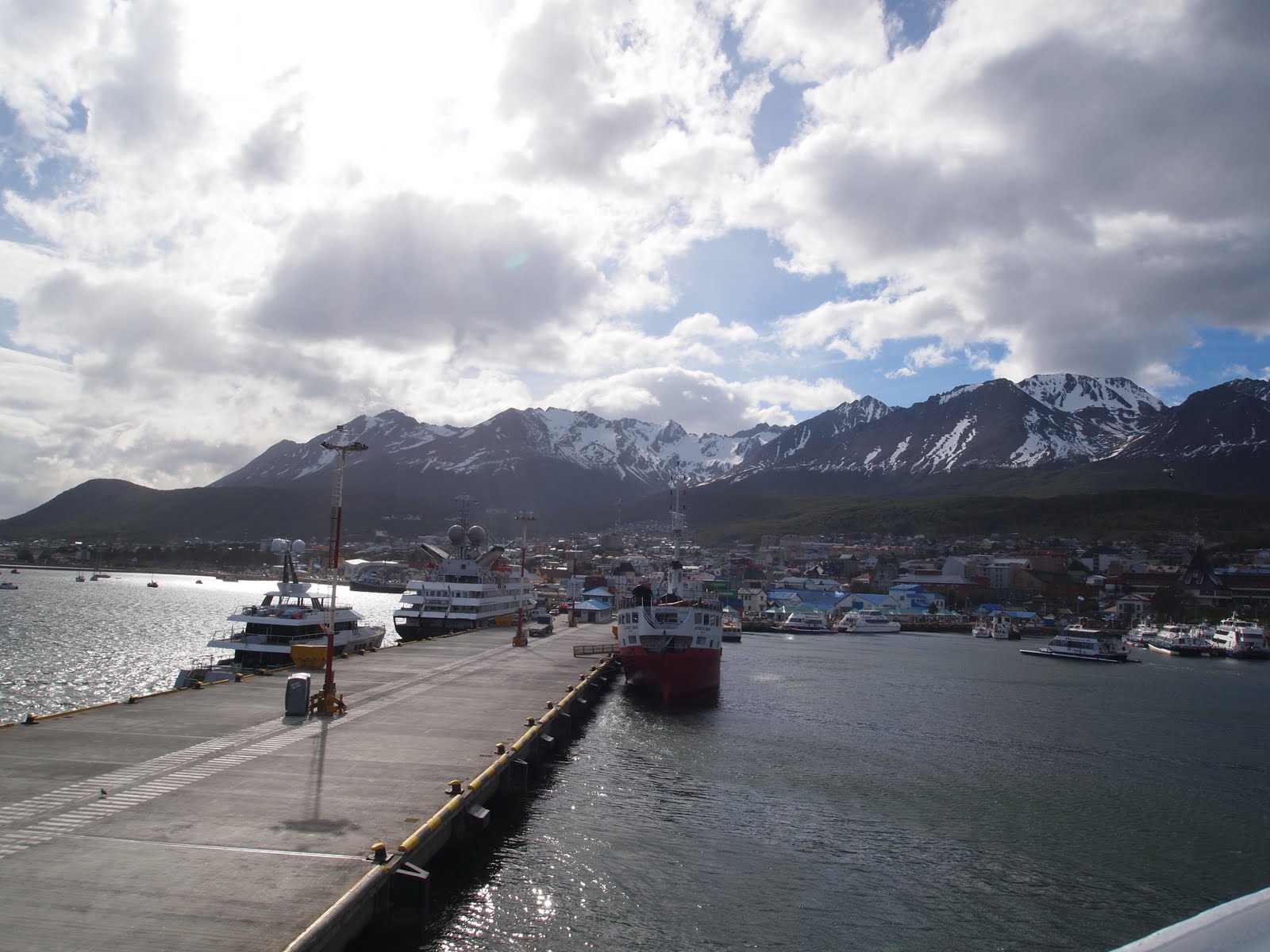
At 4 PM we arrived at the docks and boarded the MV Fram, a 240 Antarctic passenger (or 400

passengers in international waters) ship with a 1B ice breaker rating built in 2007 by a company in Cincinnati, Italy based on Norwegian design. Fram I, II, and III had also been explorer ships – the first two to the Arctic and the third to Antarctica. A few other ships were also docked, including the Clelia II which got caught in bad weather and the passengers all had to be rescued. No one died. Another ship wreck also decorated the beach.

We had dinner then watched the boat leave shore.

The next day we spent at sea, on Gravol. My mom being a pharmacist arranged for us to have a myriad of drugs, but in the end it seemed like Gravol just worked the best with the only side-effect of dopey-ness. Drugs man, drugs!


Monday, February 14, 2011

Chinese Head Tax

Canada's most ungrateful tax: The Chinese 'head' tax
From Tax Me I'm Canadian by Mark Milke and the staff of the Canadian Taxpayers Federation
There are a few things more ugly than ungratefulness. In 1885, after the completion of the Canadian Pacific Railway across Canada, and to the British Columbia where that portion was built mainly by Chinese labourers, thousands of whom died in the process, the Canadian government passed the Canadian Immigration Act.
The Act stipulated that most Chinese immigrants must pay a "capitation tax" before being granted the right to disembark. Certain occupational groups such as merchants and clergy were exempted (and later, teachers) but the "Chinese head tax," as it is more commonly known, was set at $50 in 1885, raised to $100 in 1890, and to $500 in 1903. Given the exemptions, it was mostly labourers who paid the head tax.
To understand how costly that was to workers of that period, a labourer in 1885 worked an average of 60 hours a week for an annual salary of $290. By 1905 when the tax bill was $500, the average annual earnings of a production worker in Canada were $375. So, depending on the year, the head tax was equivalent to between two months' and 16 months' worth of an average labourer's salary.
The effect of the federal legislation was to restrict the flow of Chinese immigrants - not to exclude them entirely but even that restriction was not enough for some. At the time, labour leaders and politicians in B.C. lobbied repeatedly for the full exclusion of the Chinese, sentiments they said were grounded in "concern" over competition for jobs, but stark racism was also, clearly a factor in the late 19th century. From the inception of the Act in 1885 until 1923, over 82 000 Chinese, mostly male, paid the tax, which contributed $18 million to federal coffers. A worse law -- the Chinese Exclusion Act -- that completely banned the entry of Chinese immigrants then replaced the earlier 1885 legislation.
In addition to the federal tax the British Columbia government also instituted a "Chinese tax" which collected over $7.7 million. The money was not insubstatntial, either for those forced to pay it or for the government that collected it. At its revenue peak in British Columbia, the provincial tax brought in over $1.7 million in 1913 -- or about 18% of the total $9.6 million in provincial revenues that year. The provincial "Chinese tax" was the third largest revenue source behind mainly timber royalties (31%) and the sale of timber and land (24%).
In addition to the obvious discrimination, the head taxes were tragic in other ways. The demographics of the Chinese who entered Canada (mostly male) meant there were limited opportunities for marriage given the relatively few single Chinese women (And the almost complete absence of interracial marriage). The high cost of the head tax also meant that many who were already married could not afford to send for their spouses.
Various Chinese associations have long pressed for redress and repayment through the courts and through Parliament, but the legal claim was rejected by the Ontario Superior Court in 2001 on the grounds that the 1982 constitution could not be applied retroactively. The judge did note that there was certainly no question about the inherent facism of the 1885 legislation.
Parliament could not refund the tax to Chinese descendants, but this brings up a dimlemma for today's taxpayers. To refund a voluntary tax, even one as offensive as the Chinese head tax which began in 1885 and ended nearly 8 decades ago, could open a Pandora's box where today's taxpayers might be required to compensate many for the sins of politicians of generations ago. And many of today's immigrants would pay for the policies enacted long before they or their ancestors arrived in Canada, some with equally tragic histories from the countries they fled.
Regardless of the legal and philosophical arguments for and against reimbursement, the Chinese head tax should always be remembered as Canada's most offensive tax. And given the Chinese contribution to the country's first transcontiental railroad, it is also, tragically, Canada's most ungrateful tax.

Tuesday, November 30, 2010

Bathtub Safety

Err okay, so the next article my mom sends is titled "Bathtub Safety". It's mostly funny because when I was little (maybe 5 years old) my mom wrote a set of "Bathtub Rules" in my diary.

The second heading of the article is "Adults are also at risk". LOL.

The rest of it isn't as funny (it talks about slipping and how installing a shower seat and appropriate hand rail might be good).

How to Survive if You Are Stranded on an Iceberg

So... My mom has this funny habit of sending me amusing articles in the mail. Here is the latest one:

How to Survive if You Are Stranded on an Iceberg
1. Construct a Shelter.
For protection from the harsh climate, you must build a snow shelter immediately. Your iceberg should have plentiful amounts of snow, so construct either a snow cave (make a huge pile of snow, hollow it out, and crawl inside) or a snow trench (dig a deep channel in the snow, cover the top by stacking snow blocks or improvising a tarp out of material on hand, and crawling in). A snow trench requires less energy and time to construct, but will limit your range of movement and should only be used if you expect quick rescue.

2. Melt snow and ice to make water.
Place snow in a container and melt over a flame to create drinkable water. If snow is not available, scrape shavings from the topmost layer of ice. Though sea ice contains salt, over time the salt leeches from the ice due to surface melt, and the water from the top ice should be safe for drinking.

3. Cross icebergs to get closer to land.
Wind and ocean currents will keep icebergs in motion, often causing them to crash into one another. Step onto a new iceberg if it will bring you closer to a land mass. Use caution when crossing; the edges may be very slick, and the ice may be thin and prone to cracking or collapse. Do not jump onto a new iceberg. Test the strength of the ice by pressing lightly with a foot, then adding pressure slowly until you are certain it can support your weight.

4. Catch fish and seabirds.
Fashion a fishing rod with anything available (harpoon, spear, ski pole, or walking stick) and use it for fishing. Seabirds congregate on icebergs, and may be killed with ice balls.

After that, there's a picture of a dude stretched out that says, "Do not try to reach across icebergs".

5. Look for seals.
Seals eat fish, and you may be able to scare one away from a fresh catch. As a last resort, if you're likely to be rescued for a while and can't cross onto another iceberg, and only if your life is at risk, consider killing a seal. Seals can serve as both food and a source of fuel. Unless there is a surface melt, without a fuel source you will unable to melt snow and ice for drinking water and you will quickly die of dehydration. (Avoid sucking on ice: it will lead to hypothermia). Seals will occasionally jump on drifting icebergs to escape predators and may pop up through breath holes in the ice. While out of the water, seals are generally inactive and docile. Approach adults stealthily from the rear and kill using a club, harpoon, or homemade spear to the skull.

6. Make fuel from seal blubber.
Cut blubber (fat) from the seal carcass and place in the best bowl you can fashion. Using an implement, pound the blubber until it liquefies. Roll a small piece of material into a wick, place it in the blubber, and light.

7. Roast or boil seal meat for food.

8. Burn moist seal skins to create smoky signal fires during the day.
However, your best chance of polar rescue is from land. Just because a ship can see you on an iceberg does not mean it can rescue you.

Be Aware

  • Small penguins are also good food source. Penguins have most of their strength in their flippers, however, so avoid by being bashed by a flipper when hunting by approaching from the rear and pinning wings to the sides. Avoid attacking from the front or you risk being badly "beaked".
  • In antarctica, which is a frozen landmass surrounded by ice, icebergs tend to drift in a clockwise pattern around the South Pole, pushed by the circumpolar current. An iceberg may eventually pass a populated weather station or move into a shipping channel. (Weather and research stations may be located hundres of miles apart in polar regions). In the Arctic, which is a frozen sea, the currents also move clockwise, east to west, around the polar ice cap. However, the transpolar drift, a current that carries water and ice eastward from Siberia, may bring an iceberg down the east coast of Greenland into more populated areas. The trip from the edge of the Arctic may take several months

Sunday, November 21, 2010

Real T- 'T' Shirts...


'T'-Shirts
Are shirts designed after the letter 'T' in 5 popular fonts: Helvetica, Caslon, Baskerville, Courier and Copper Black. Strangely, none of these fonts other than Courier are useable fonts in Blogger. Well, you get the idea anyway.


Saturday, November 20, 2010

Victoria Secret


New Animals to the Endangered Species List


These photos were collected from BBC's Earth News. Click for larger images.